salam rakan blogger~~
dah dekat habis sem dah..biasa la mesti every sem akan buat dinner fakulti...2 hari yang lepas FAKULTI INFORMATIK (FITS) mengadakan Dinner FITS bagi meraikan pelajar ijazah sarjana muda sains komputer semester 7, diploma multimedia semester 5 dan diploma teknologi maklumat semester 5...bertempat di SUTRA BEACH RESORT AND SPA di Merang....lebih kurang 25 minit dari Gong Badak...45 minit dari Bandar Kuala Terengganu....
TEMA DINNER : FAIRY TALE vs ROCK STAR vs 1MALAYSIA vs BLACK AND WHITE
meriahkan temanya....ni last dinner syu dengan classmate yang lain...dah final year...next sem masing-masing dah praktikal jauh-jauh...time grad nanti baru jumpa...so memang banyak giler ar kitorang bergediks snap picture kat situ....adehhh....jom kita layan gambar dinner 4 themes.....

~of course la gambar syu dulu kan...hehehe~

~Mr Popular 2010 and Mrs Popular 2010~
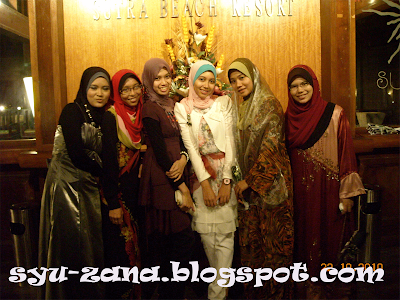
~me and my frenz...cun-cun suma....~

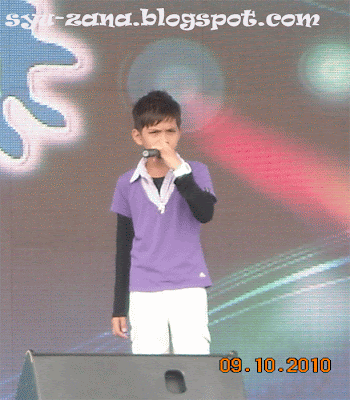
~persembahan...nyanyi ramai2...lagu Suara Ku Berharap - Hijau Daun~

~syu, Prof. Madya Dr Nordin (Dekan FITS), ain~

~with timbalan dekan FITS : En Suhailan~

~boys...kalu berkenan nak buat pakwe ke menantu ke, sila inform yer :p~

~gediks time...my classmate~

~candid my classmate klik*klik*~

~SUTRA BEACH RESORT~
more pic in RAINBOWCLOUDY
layan lagu ni jap....seharian sebelum g dinner dok dengar lagi ni je...sebab nak nyanyi malam tu kan....macam best la plak lama-lama dengar (^_^)
Lirik Lagu Hijau Daun – Suara (Ku Berharap)
di sini aku masih sendiri
merenungi hari-hari sepi
aku tanpamu, masih tanpamu
bila esok hari datang lagi
ku coba hadapi semua ini
meski tanpamu oooh meski tanpamu
bila aku dapat bintang yang berpijar
mentari yang tenang bersamaku disini
ku dapat tertawa menangis merenung
di tempat ini aku bertahan
reff:
suara dengarkanlah aku
apa kabarnya pujaan hatiku
aku di sini menunggunya
masih berharap di dalam hatinya
suara dengarkanlah aku
apakah aku slalu dihatinya
aku di sini menunggunya
masih berharap di dalam hatinya
kalau ku masih tetap disini
ku lewati semua yang terjadi
aku menunggumu, aku menunggu
reff2:
suara dengarkanlah aku
apa kabarnya pujaan hatiku
aku di sini menunggunya
masih berharap di dalam hatinya
suara dengarkanlah aku
apakah aku ada dihatinya
aku di sini menunggunya
masih berharap di dalam hatinya
repeat reff
suara dengarkanlah aku